
 Cleveland Museum of Art · CC0 1.0
The responsibility of the auction
An auctioneer commits their house at every hammer: accuracy of descriptions, checking of provenance, respect for warranties. The two-day programme, followed by 900 professionals, reviews these responsibilities and proposes methods of control.
It was designed with representatives of approved auction houses and magistrates. It prepares for OIMAP approval and application of the code of ethics.
This page details the content and formats.
Training for auctioneers in figures
Source: OIMAP Academy.
Conditions of sale and warranties
The programme reviews the drafting of general conditions of sale, catalogue descriptions and their effect, warranties of authenticity and condition, limitation clauses and the TAO arbitration clause. Real cases of disputes show the mistakes to avoid.
Participants leave with an updated model of conditions of sale.
Estimate, description, catalogue
An accurate description protects the seller as much as the buyer. The module teaches how to write precise entries, flag restorations, use attribution terms with rigour and document estimates. It covers liability in case of error.
A workshop deals with critical proofreading of real catalogues.
Due diligence and compliance
Before putting a lot up for sale, the house must check provenance, the seller's identity, the absence of a BIOP alert and compliance with export rules. The module presents the standard procedure: questionnaire to the seller, research, consultation of databases, documentation.
It also covers anti-money-laundering and counter-terrorist financing.
Online and hybrid sales
Online sales multiply bidders and risks: identity, solvency, proof of acceptance of conditions, delivery times, transfers of ownership. The module explains how to secure the process, with a tick box for the arbitration clause and verification procedures.
It presents the framework of platforms approved by OIMAP.
Two-day programme
| Day | Themes | Format |
|---|---|---|
| 1 | Conditions of sale, warranties, descriptions | Talks, cases |
| 2 | Due diligence, online sales, approval | Workshops |
Milestones
- First sessions
Auction houses.
- Approval
Link with the programme.
- Online sales
Module.
- 900 professionals
Review.
Document your checks
Independent house or group
Independent
Small structure- Flexibility
- Training of a lead person
- Limited means
One lead person is enough.
Group
Several sites- Common procedures
- Cascade training
- Higher cost
In-house programme.
Upgrading your house
- Train
Managers.
- Audit
Practices.
- Draft
Procedures.
- Apply
Sales.
- Get approved
OIMAP.
To put in place
An auctioneer
« Before the training, we checked out of habit. Now we check by method, and we can demonstrate it. »
Vocabulary of auctions
- Hammer (award)
- Award of a lot.
- General conditions of sale
- Rules of the sale.
- Money laundering
- Concealment of the origin of funds.
- Approved platform
- Site recognised by OIMAP.
Approval and label
Auction houses can apply for OIMAP approval, granted in five days for €540 excluding tax, and the compliance label (€1,200 a year). Training is one of the criteria. The module details the steps and audits.
A one-year follow-up supports implementation.
To go further
The Academy's reception service answers practical questions Monday to Friday, in French, English and Spanish, and can direct each visitor to the programme, scholarship or free resource that fits their situation. A guidance counsellor also offers a thirty-minute individual meeting, by appointment, to build a realistic training pathway.
Trainees' feedback is valuable: each session gives rise to a questionnaire, and the most useful suggestions are examined each quarter by the teaching committee. Do not hesitate to write to report a difficulty, propose a subject or tell us what the training has changed in your practice.
Frequently asked questions
Does the programme prepare for approval?
Yes.
How much does it cost?
About €900.
Is there an online version?
A short version.
Where to see gallery owners?
See Gallery owners.
Useful documents
Contacts
Related pages
 Market professionalsAuctioneers, gallery owners and collectors: training to buy, sell and conserve safely.›
 Training for gallery ownersContracts with artists, provenance, consignment, fairs and online sales: the programme for galleries.›
 Training for collectorsAcquiring with discernment, documenting one's collection and passing it on: a one-day programme for private collectors.›
See gallery owners
Image credits (16)
- Views: The Market on the Molo, Antonio Canaletto (1735–1746) — Cleveland Museum of Art, CC0 1.0
- Leaf from a Lectionary with St. Luke (1057–1063) — Cleveland Museum of Art, CC0 1.0
- At the Market, Camille Pissarro (late 1800s) — Cleveland Museum of Art, CC0 1.0
- Portrait of a Man, Italian Painter — The Metropolitan Museum of Art, CC0 1.0
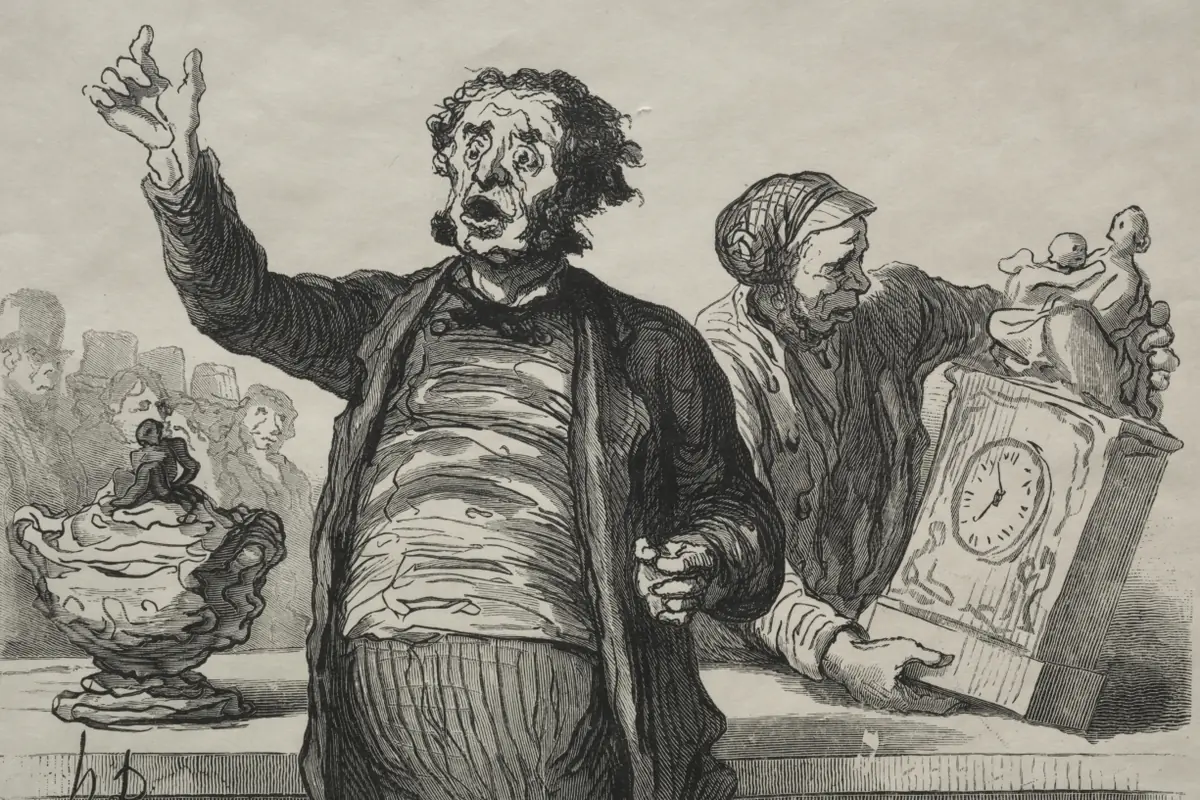
- The Auction House: The Town Crier, Honoré Daumier (1864, printed 1920) — Cleveland Museum of Art, CC0 1.0
- Bookplate: Boylston Medical Library, George Girdler Smith (1806–39) — Cleveland Museum of Art, CC0 1.0
- An Old Clothes Shop, Seven Dials, John Thomson (1877) — Cleveland Museum of Art, CC0 1.0
- Portrait Bust of a Man (27 BCE–14 CE) — Cleveland Museum of Art, CC0 1.0
- The Market Place, Wells, Muirhead Bone (1891–1953) — Cleveland Museum of Art, CC0 1.0
- A Lady Reading, Francis Seymour Haden (1833–1910) — Cleveland Museum of Art, CC0 1.0
- The Four Markets: The Fruit Market, Richard Earlom (1775) — Cleveland Museum of Art, CC0 1.0
- Small Mosque in the Kaiserbagh, Felice A. Beato (1858) — Cleveland Museum of Art, CC0 1.0
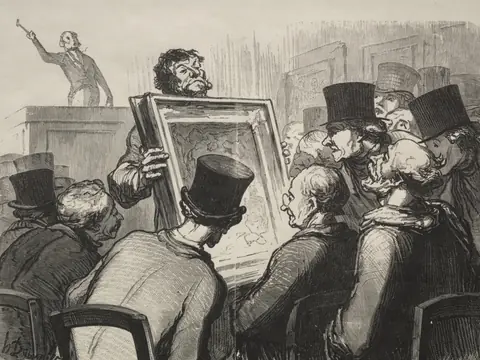
- Painting Enthusiasts at Auction House Bouillon, Honoré Daumier (1862, printed 1920) — Cleveland Museum of Art, CC0 1.0
- Christ Driving the Money Changers from the Temple, Rembrandt van Rijn (1635) — Cleveland Museum of Art, CC0 1.0
- Portrait of a Woman, Corneille de Lyon (c. 1540) — Cleveland Museum of Art, CC0 1.0
- Self-Portrait, John I Smart (1802) — Cleveland Museum of Art, CC0 1.0