
 Cleveland Museum of Art · CC0 1.0
Your data, your rights
OIMAP processes your personal data with transparency and restraint. It collects only the information necessary for its services and keeps it for a limited period. The data protection officer ensures compliance with these rules.
This page describes the data collected, your rights and how to make contact. It supplements the legal notice and the page on cookies.
Personal data in figures
Source: OIMAP General Secretariat.
The data collected
Depending on the service, the Organisation collects identity data (name, position, organisation), contact details (email, telephone, address), professional data (qualifications, experience) and, for the Desk, documents proving ownership or provenance of a work.
No sensitive data in the strict sense is requested. If data of this nature appears in a file, it is processed with enhanced safeguards and limited to what is strictly necessary.
Why and on what basis
Each processing operation has a specific purpose: examining a certification request, enrolling an official in a training course, replying to a message, reviewing an application. The legal basis is, as the case may be, the performance of a public-interest task, compliance with a legal obligation or your consent.
For processing based on consent, you may withdraw it at any time, without affecting the lawfulness of operations already carried out.
Retention periods
Data is kept only as long as necessary. A message sent through the contact form is kept for three years (indicative). A certification file is kept for the validity period of the certificate, then archived for the period required by applicable law.
Unsuccessful applications are deleted after two years (indicative), unless the applicant agrees to be contacted about other offers.
Recipients and transfers
Only authorised staff access the data, within the limits of their duties. Technical providers act as processors and are bound by contract: they may use the data only on the Organisation's instructions.
Transfers outside the European Economic Area may take place, for example to the offices in New York, Singapore or Nairobi. They are governed by equivalent protection clauses.
The main processing operations
| Processing | Purpose | Retention (indicative) |
|---|---|---|
| Certification file | Examination of a request | Duration of the certificate, then archiving |
| Training enrolment | Management of trainees | 5 years |
| Contact form | Reply to a message | 3 years |
| Application | Recruitment | 2 years if unsuccessful |
Milestones
- Statutes
Confidentiality obligation of staff.
- GDPR alignment
Appointment of an officer (indicative).
- Register of processing
Publication of purposes (indicative).
- Current version
Policy update.
Consent or public task
Consent
Your free choice- Can be withdrawn
- Specific and informed
- Used for newsletters
At any time.
Public task
A mission of the Organisation- Examination of files
- Management of certification
- Objection possible in some cases
For official services.
Exercising a right
- Choose
The right to exercise.
- Write
At dpo@oimap.example.
- Prove
Your identity.
- Receive
A reply within one month.
- Refer
The supervisory authority if needed.
Before writing
A Desk user
« I was able to have an error in my file corrected within a few days, with a clear reply from the officer. »
Vocabulary
- Legal basis
- Legal foundation of a processing operation.
- Processor
- Provider that processes data on behalf of the Organisation.
- Portability
- Right to retrieve one's data in a reusable format.
- Registry
- List of data processing operations.
Exercising your rights
You may request access to your data, its rectification, erasure, restriction of processing and portability, and object to certain processing. Write to the data protection officer: dpo@oimap.example. Proof of identity may be requested to prevent impersonation.
If you consider that your request has not received a satisfactory reply, you may refer the matter to the data protection authority of your country of residence. In the event of a data breach, the Organisation informs the persons concerned as soon as possible.
Frequently Asked Questions
Who is the officer?
An independent official, reachable at dpo@oimap.example.
Is my data sold?
No, never.
How long is it kept?
Depending on the processing: see the table.
How do I refuse a cookie?
See Cookies.
Useful Documents
Contacts
Related Pages
 Legal NoticesThe site publisher, the processing of personal data and the use of cookies: the legal framework of this site.›
 Site publisherThe identity of the publisher, the publication director, the host and the means of contacting the editorial team.›
 CookiesThe cookies set by this site: essential cookies only, plus anonymised audience measurement, and how to manage your choices.›
 Access to informationHow to request a document that OIMAP has not published: form of the request, 30-day time limit, grounds for refusal and appeals.›
Contact the officer
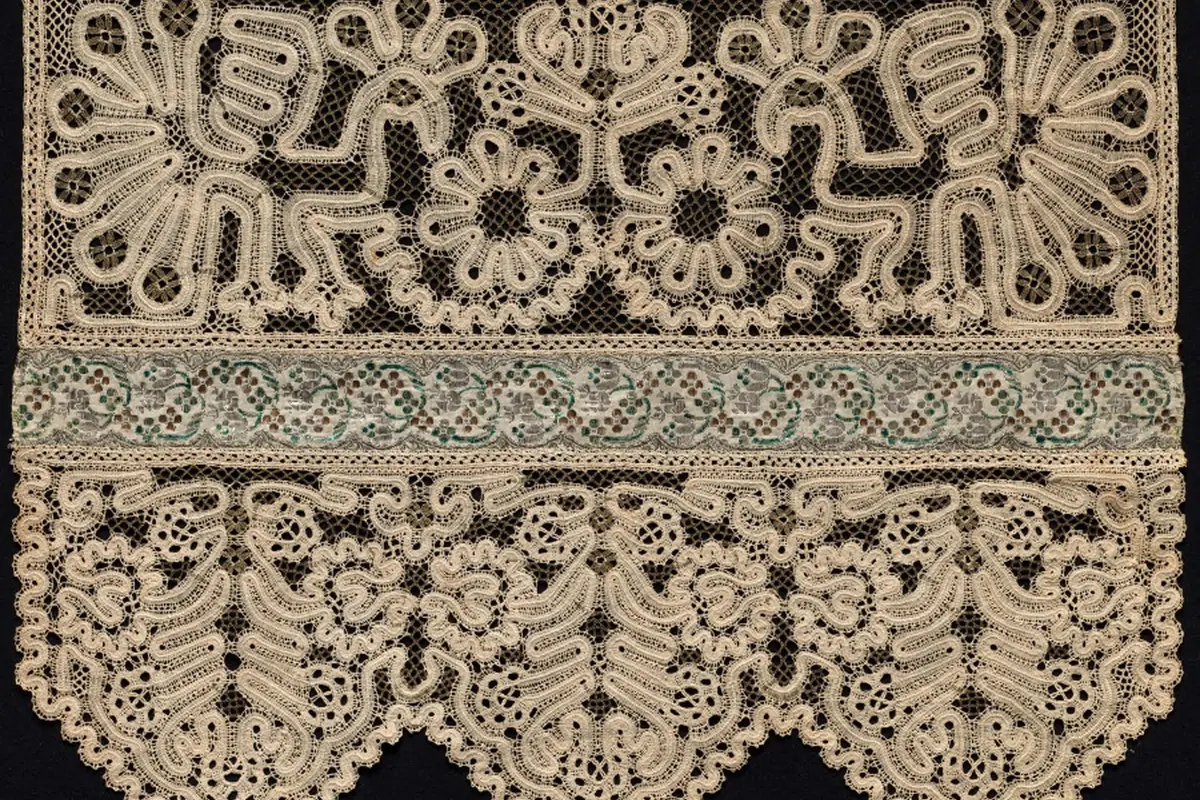
Image credits (17)
- Eighteen Views of Rome: The Piazza Farnese (recto), Lievin Cruyl (1664) — Cleveland Museum of Art, CC0 1.0
- The Dance at the Court of Herod, Israhel van Meckenem (c. 1500) — Cleveland Museum of Art, CC0 1.0
- Sketch of the Labyrinth of the Villa Pisani, Francesco Guardi (1773–1778(?)) — Cleveland Museum of Art, CC0 1.0
- Farmhouse on the Slope of a Hill, Fra Bartolommeo (c. 1508) — Cleveland Museum of Art, CC0 1.0
- Capriccio: A Palace with a Courtyard by the Lagoon, Antonio Canaletto (c. 1750–55) — Cleveland Museum of Art, CC0 1.0
- Coronation of the Virgin, Christoffel Jegher (1632–36) — Cleveland Museum of Art, CC0 1.0
- The Old Market, Cleveland, Frank Wilcox (1920) — Cleveland Museum of Art, CC0 1.0
- Bidri Hookah Bowl with Roses (c. 1650s) — Cleveland Museum of Art, CC0 1.0
- The Doge's Palace, Venice, Richard Parkes Bonington (1826) — Cleveland Museum of Art, CC0 1.0
- The Victory Banquet: from Battle Scenes of the Quelling of Rebellions in the Western Regions, with Imperial Poems (c. 1765–74; poem dated 1760) — Cleveland Museum of Art, CC0 1.0
- Architectural Conference (c. 1622) — Cleveland Museum of Art, CC0 1.0
- Châteauvieux-sur-Suran, Antoine-Claude Ponthus-Cinier (1848) — Cleveland Museum of Art, CC0 1.0
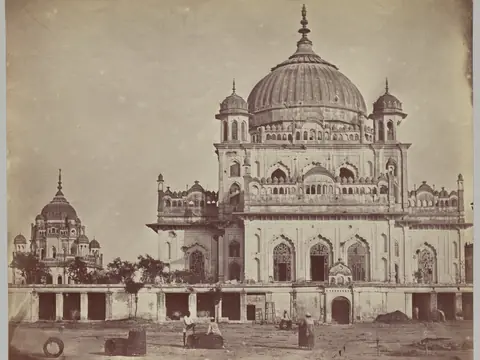
- Small Mosque in the Kaiserbagh, Felice A. Beato (1858) — Cleveland Museum of Art, CC0 1.0
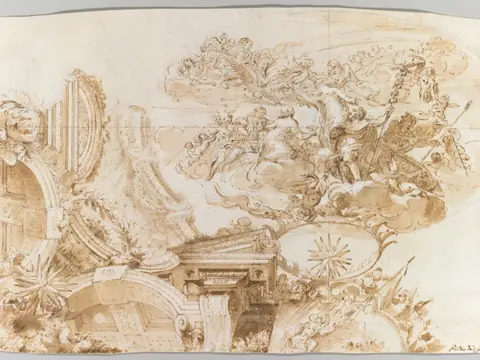
- The Apotheosis of Romulus: Design for a Ceiling, Domenico Maria Canuti (c. 1675–76) — Cleveland Museum of Art, CC0 1.0
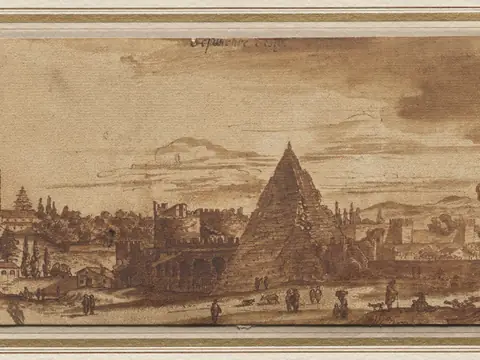
- The Pyramid of Cestius, Rome, Michiel van Overbeek (c. 1650–80) — Cleveland Museum of Art, CC0 1.0
- The Grotto of Posillipo, Hubert Robert (c. 1769) — Cleveland Museum of Art, CC0 1.0
- Lace Towel End (c. 1700s–1800s) — Cleveland Museum of Art, CC0 1.0