
 Cleveland Museum of Art · CC0 1.0
Mapping the shadow
Because it is clandestine, trafficking in cultural property is poorly known. OIMAP, with its partners, has developed an estimation method based on three sources: seizures, reports in the BIOP database and field investigations. From it, it draws an indicative overview, regularly updated.
The overview distinguishes regions of origin, transit countries and destination countries. It also describes the most sought-after property and the factors that favour looting.
It serves as a basis for prevention policies and aid to States.
Overview of illicit trafficking in figures
Source: OIMAP Heritage Protection Department.
Regions and routes
Regions with a high density of archaeological sites — the Middle East, North Africa, South-East Asia, Latin America — are the most affected by looting. Routes often go through transit countries where controls are weaker, before arriving in destination markets in Europe, North America or Asia.
Free ports, certain free zones and small regional salerooms are sometimes used to blur provenance. WCO and INTERPOL controls target these links.
Targeted property and motivations
The most sought-after property combines high value, small volume and limited documentation: coins, jewellery, statuettes, cylinder seals, manuscripts, masks. Contemporary works of art, being more recent, are increasingly targeted by opportunist thefts.
Motivations vary: profit for organised networks, subsistence for local populations, financing of conflicts in certain regions. This diversity calls for different responses, from repression to economic aid.
The role of digital
The Internet has transformed trafficking: online listings, social networks and messaging apps make it possible to offer property worldwide with little control. Platforms approved by OIMAP have committed to checking at-risk listings, but the phenomenon continues to evolve.
Payments in crypto-assets, delivery by intermediaries and the sale of tokens backed by works add new opportunities for concealment. It is a field of permanent monitoring for the BIOP unit and the authorities.
International responses
Faced with the worldwide dimension of the phenomenon, responses are organised at several levels: international conventions (UNESCO 1970, UNIDROIT 1995), police cooperation with INTERPOL, customs cooperation with the WCO, and national schemes for protecting sites.
OIMAP complements this system with the BIOP database, operators' due diligence and training programmes. It argues for a comprehensive approach, combining prevention, control and awareness-raising.
Regions of looting and destination
| Region | Main role | Typical property |
|---|---|---|
| Middle East | Origin | Cylinder seals, statuettes, coins |
| Africa | Origin and transit | Masks, sculptures, bronzes |
| Latin America | Origin | Ceramics, goldsmiths' work |
| South-East Asia | Origin and transit | Bronzes, statues |
| Europe, North America, Asia | Destination | All property |
Landmarks
- First work
Working group.
- First estimate
Shared method.
- Thematic report
Trafficking and digital.
- Updated overview
Data from 54 countries.
Estimates, not certainties
Source or destination
Source country
Where property is looted or stolen- Rich heritage
- Limited means
- Need for support
Priority of prevention.
Destination countries
Where property is sold- Active market
- Means of control
- Operators' responsibility
Priority of due diligence.
Reading an overview
- Choose
Define the region.
- Compare
Examine the trends.
- Cross-check
Use the alerts.
- Interpret
Take the limits into account.
- Act
Adapt your practices.
Points of vigilance
An archaeologist
« When a site is looted, it is not only the object that disappears, it is the whole context that made it possible to understand it. »
Vocabulary of the overview
- Source country
- State from which property comes.
- Transit countries
- State through which property passes.
- Free zone
- Zone with reduced taxation.
- Cylinder seal
- Small engraved cylindrical object of Antiquity.
Frequently asked questions
Where do these estimates come from?
From seizures, the BIOP and investigations.
Is trafficking increasing?
Reports rose by 12% in 2024, which partly reflects better detection.
What share is linked to conflicts?
It is impossible to quantify precisely.
Where can I find more details?
See Reports.
Useful documents
Contacts
Related pages
 Fighting illicit traffickingUnderstanding and combating trafficking in cultural property: overview, networks, reports and international cooperation.›
 The networks of traffickingHow looted or stolen property reaches the lawful market: steps, actors, provenance-laundering techniques and breaking points.›
 Reports on illicit traffickingOIMAP publications on trafficking: annual report, thematic studies, summary notes and open data.›
See the networks
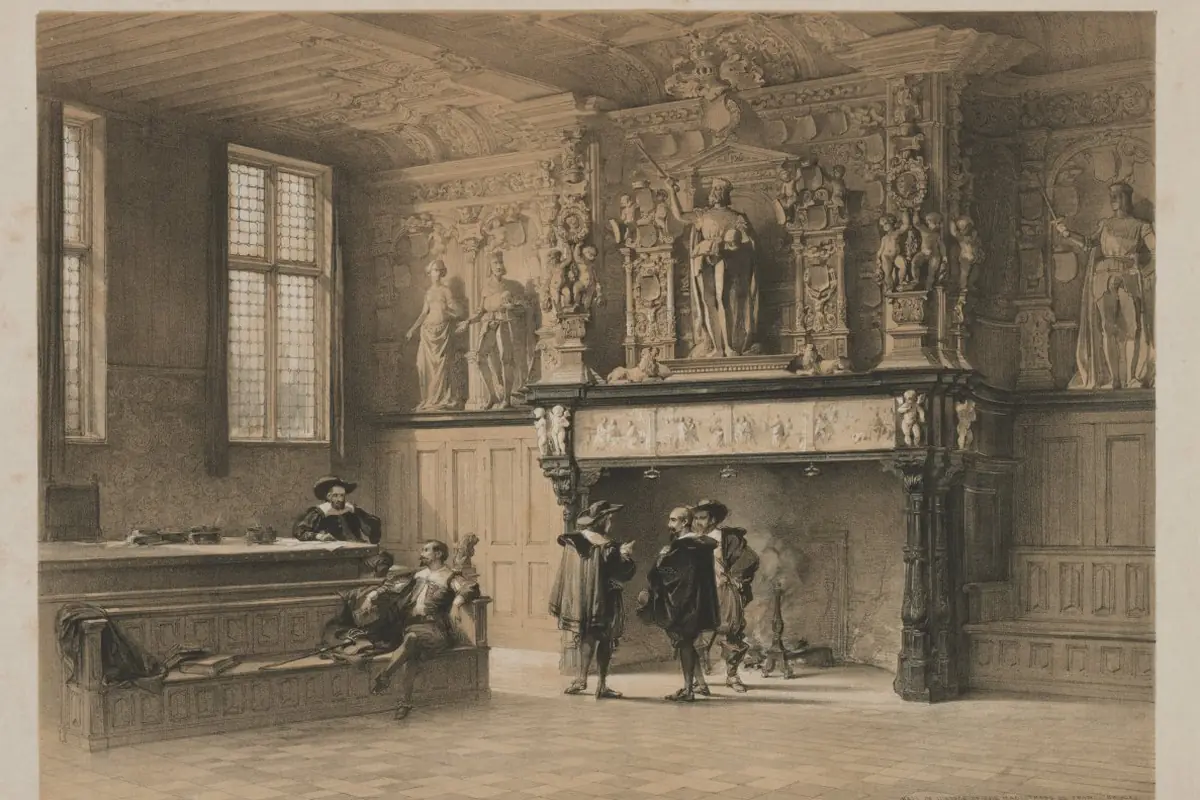
Image credits (16)
- Return of the Fishing Boats at Collioure, near the Spanish Border, Adolphe Appian (1878) — Cleveland Museum of Art, CC0 1.0
- Two Boats with Female Mourners (c. 667–647 BCE) — Cleveland Museum of Art, CC0 1.0
- Fishing Boats along the Beach, Eugène Isabey (c. 1830) — Cleveland Museum of Art, CC0 1.0
- The Calumny of Apelles, Giorgio Ghisi (1560) — Cleveland Museum of Art, CC0 1.0
- Net Fishing at Night on the Sumida River, Kitagawa Utamaro (c. 1800) — Cleveland Museum of Art, CC0 1.0
- Mit Rahina Ware Vessel (200–100 BCE) — Cleveland Museum of Art, CC0 1.0
- Sailing Vessels: Armed Four-Master Putting Out to Sea, Pieter Bruegel (1561–65) — Cleveland Museum of Art, CC0 1.0
- Dr. James Stuart; Mary Campbell Stuart, Gilbert Stuart (c. 1815) — Cleveland Museum of Art, CC0 1.0
- Landscape with Saint John the Baptist, Herri met de Bles (c. 1540) — Cleveland Museum of Art, CC0 1.0
- Talatat: Nefertiti Offers to the Aten (1353–1347 BCE) — Cleveland Museum of Art, CC0 1.0
- Sketchbook, The Dells, N° 127, page 090 & 91: Harbor with a Road, Maurice Prendergast (c. 1919–1921) — Cleveland Museum of Art, CC0 1.0
- Small Mosque in the Kaiserbagh, Felice A. Beato (1858) — Cleveland Museum of Art, CC0 1.0
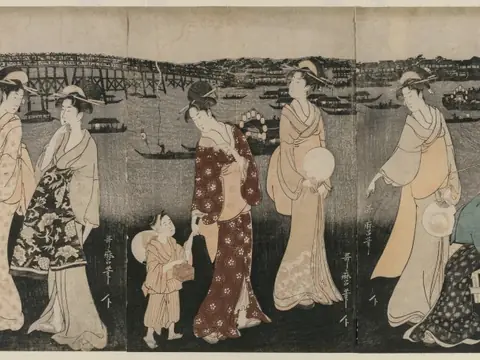
- Enjoying the Evening Cool Along the Sumida River, Kitagawa Utamaro (c. 1797–98) — Cleveland Museum of Art, CC0 1.0
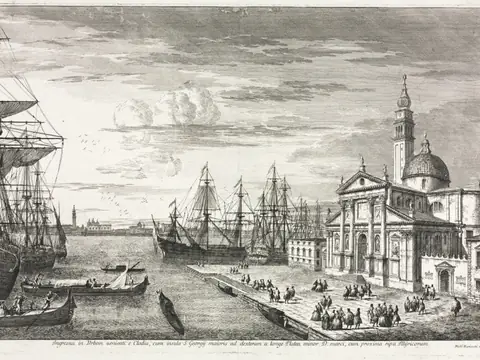
- S. Giorgio Maggiore, Michele Marieschi (1741) — Cleveland Museum of Art, CC0 1.0
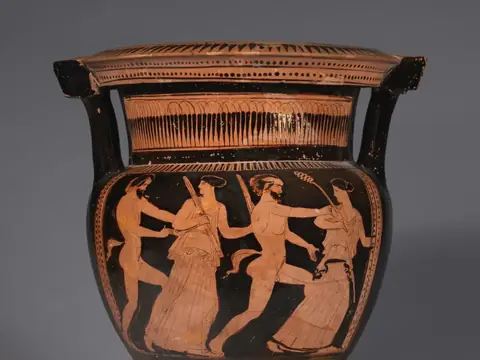
- Red-Figure Column Krater (Mixing Vessel): Satyrs Pursuing Maenads, Naples Painter (440–430 BCE) — Cleveland Museum of Art, CC0 1.0
- Sketches in Belgium and Germany, Volume I: Hall of Justice of the Magistrates du Franc, Bruges, Louis Haghe (1840) — Cleveland Museum of Art, CC0 1.0