
 Cleveland Museum of Art · CC0 1.0
Five days to secure a sale
The approval procedure is deliberately fast: five working days from a complete file. It follows a simple but strict course, which this page details step by step.
The file is submitted by the auction house for one lot or for an entire catalogue. Each lot is checked individually and receives a separate decision: a refused lot does not prevent approval of the others.
The result is a compliance opinion per lot, which can be published in the catalogue with the OIMAP mention.
The procedure in figures
The detailed course
- 1. Submission of the file1 day
The auction house submits one file per catalogue, with a sheet for each lot.
- 2. Admissibility1 day
Verification of completeness and payment.
- 3. Checks2 days
Identity, seller, alerts, provenance: four checks that are automated and validated by an officer.
- 4. Decision1 day
Approval, approval with reservation or reasoned refusal for each lot.
- 5. Notification0 days
The house receives the opinions and may publish the OIMAP mention.
Documents per lot
| Document | Mandatory? |
|---|---|
| OIMAP number of the work | Yes |
| Seller's title of ownership or mandate | Yes |
| Consignment contract | Yes |
| Provenance certificate | For works more than 100 years old |
| Certificate of authenticity | Recommended |
| Conservation report | Optional |
Three possible outcomes
Catalogue file or lot file
Catalogue file
Several lots- A single payment
- A single contact
- 10% discount from 20 lots
For public sales.
Lot file
A single lot- Standard rate
- Individual handling
- Suited to private sales
For individual lots.
The five days
- Submission
File and deposit.
- Admissibility
Completeness checked.
- Checks
Four checks per lot.
- Decision
Opinion and notification.
Case study: an approval with reservation
A gap flagged
A painting has an eight-year gap in provenance, with no indication of spoliation.
- The provenance certificate is at the “minor gaps” level.
- Approval is issued with a reservation.
- The catalogue mentions the gap.
The painting is sold without dispute, the buyer having been informed.
What to do in case of refusal
A refusal is always reasoned in writing. The most frequent grounds are insufficient proof of ownership, an alert or a significant gap in the provenance of a sensitive work.
The auction house has 15 days to request a review by completing the file. The review is charged at 30% of the initial price. As a last resort, the Arbitral Tribunal may be seized.
A service requirement
« Five days is short. That is why a lot file must arrive complete. »
Vocabulary of the procedure
- Approved with reservation
- Positive opinion accompanied by a mandatory mention in the catalogue.
- Review
- New examination at the request of the auction house.
- Lot sheet
- Document describing a lot and its documents.
- OIMAP mention
- Logo and number attesting approval.
Frequently asked questions
Can I request approval after the lot is in the catalogue?
Yes, but the OIMAP mention may only appear after the decision.
Is approval public?
The mention is; the file remains confidential.
Can a lot already sold be approved?
No: approval comes before the sale.
How many lots per file?
Up to 200 lots per catalogue file.
Useful documents
Contacts
Related pages
 Auction housesThe role of auction houses in the certification chain, their obligations and the directory of approved houses.›
 Private salesThe rules specific to private-treaty sales: named approval, confidentiality, transfer of ownership and reporting obligations.›
 Submit a caseDescribe the work, choose the acts, upload the documents and pay the deposit: submitting a case step by step.›
Submit a case
Image credits (16)
- Creamer, Louis Rorimer (c. 1910) — Cleveland Museum of Art, CC0 1.0
- Carnet (1863–1865) — Cleveland Museum of Art, CC0 1.0
- Plate: Diana and Acteon, Maestro Giorgio Andreoli (1522) — Cleveland Museum of Art, CC0 1.0
- The Four Seasons, Kano Tan’yū (1668) — Cleveland Museum of Art, CC0 1.0
- Yokkaichi: View of the Mie River, from the series The Fifty-Three Stations of the Tōkaidō, Utagawa Hiroshige (c. 1833–34) — Cleveland Museum of Art, CC0 1.0
- Fish or Seal Club (X’ús’) (late 1800s–early 1900s) — Cleveland Museum of Art, CC0 1.0
- Christ Driving the Money Changers from the Temple, Rembrandt van Rijn (1635) — Cleveland Museum of Art, CC0 1.0
- Portrait of a Man, Gustave Caillebotte (1880) — Cleveland Museum of Art, CC0 1.0
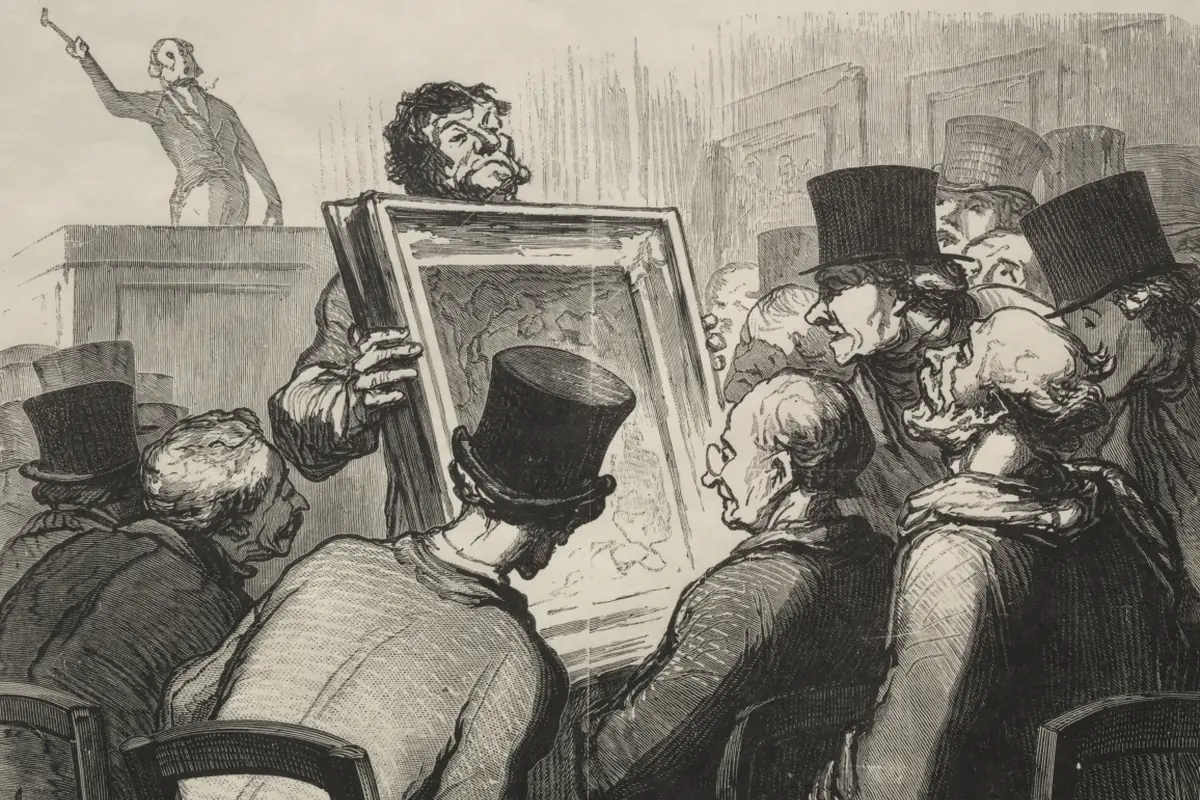
- Painting Enthusiasts at Auction House Bouillon, Honoré Daumier (1862, printed 1920) — Cleveland Museum of Art, CC0 1.0
- Document Box (Ryōshibako) with Chrysanthemum and Plum (lid) (late 1800s-early 1900s) — Cleveland Museum of Art, CC0 1.0
- Teapot, Louis Rorimer (c. 1910) — Cleveland Museum of Art, CC0 1.0
- Architectural Conference (c. 1622) — Cleveland Museum of Art, CC0 1.0
- Sugar Bowl, Louis Rorimer (c. 1910) — Cleveland Museum of Art, CC0 1.0
- Portrait Bust of a Man (27 BCE–14 CE) — Cleveland Museum of Art, CC0 1.0
- Chemin de fer de Toulouse à Bayonne. Pont de l'Aran (en trois arches de 17m d'ouverture chacune). Situation des travaux au 21 juillet 1861, Édouard Baldus (1861) — Cleveland Museum of Art, CC0 1.0
- Edge of the Woods Near L'Hermitage, Pontoise, Camille Pissarro (1879) — Cleveland Museum of Art, CC0 1.0