
 Cleveland Museum of Art · CC0 1.0
Buying competitively
OIMAP buys goods and services for its operations: IT, printing, translation, event hosting, consulting services. Above a threshold of €40,000 (indicative), a purchase is subject to competitive tendering.
Notices are published online and accessible to all companies, whatever their country. This page complements the public documents and the oversight exercised by the audit.
Public procurement in figures
Source: OIMAP General Secretariat.
The principles
The Organization's purchases rest on four principles: equal treatment of candidates, transparency of the procedure, sound use of public funds and prevention of conflicts of interest. No candidate receives information that is not communicated to all.
The Administration and Finance Directorate conducts the procedures. An evaluation committee separate from the requesting department examines the bids, to prevent the same staff member from both specifying and awarding.
Procedure thresholds
Below €10,000 (indicative), the purchase is made by direct agreement, with written justification. Between €10,000 and €40,000, at least three quotes are requested. Above €40,000, a call for tenders is published, with specifications and weighted criteria.
Urgent purchases, linked for example to a heritage protection operation, may follow an accelerated procedure. They are then reported in the annual audit report.
Submitting a bid
The procurement notice states the subject, the duration, the documents to be provided and the deadline. Candidates submit their questions in writing; the answers are communicated to all. The bid includes a presentation of the company, its references and its price.
Companies must certify that they are up to date with their tax and social obligations and that they are not in a situation of conflict of interest with staff of the Organization.
Award and monitoring
The award criteria combine price, technical quality, delivery times and, for some contracts, the ability to work in the three official languages. The result is notified to all candidates with the reasons for the choice.
Contract monitoring is entrusted to the requesting department and to the Administration and Finance Directorate. Amendments are limited and justified, and payments are made after verification that the service has been delivered.
Procedures by amount
| Amount (indicative) | Procedure | Publicity |
|---|---|---|
| Less than €10,000 | Justified direct agreement | Internal register |
| €10,000 to €40,000 | Three quotes | Annual list |
| More than €40,000 | Call for tenders | Notices online |
| Emergency | Accelerated procedure | Mention in the audit |
Milestones
- Financial regulations
First purchasing rules of the Organization.
- Notices online
Systematic publication of calls for tenders (indicative).
- Declarations of interests
Obligation for members of evaluation committees (indicative).
- €40,000 threshold
Reference threshold in force.
Candidate or contract holder
Candidate
Before the award- Reads the notice
- Submits questions in writing
- Submits a bid before the deadline
Competes on equal terms.
Contract holder
After the award- Signs the contract
- Delivers on time
- Is paid after the service is delivered
Performs the service.
Responding to a call for tenders
- View
The procurement notice.
- Read
The specifications.
- Ask
In writing, before the deadline.
- Submit
The complete bid.
- Wait
Notification of results.
- Request
The reasons in the event of rejection.
Before submitting a bid
An SME manager
« Because the questions and answers were communicated to all candidates, we were able to respond on an equal footing with larger companies. »
Vocabulary
- Call for tenders
- Public competitive procedure.
- Direct agreement
- Negotiated purchase without formal competition.
- Service delivered
- Verification of delivery before payment.
- Amendment
- Written modification of a contract in progress.
Oversight and remedies
Contracts are overseen by the internal audit and by the external auditor. An unsuccessful candidate may request the reasons for the decision, then refer the matter to the Arbitration and Ethics Committee if they consider the procedure irregular.
Companies may also use the confidential whistleblowing channel to report a practice contrary to the rules.
Frequently Asked Questions
From what amount is a call for tenders launched?
€40,000 (indicative).
Where can the notices be seen?
In this section, online.
Can a foreign candidate respond?
Yes, whatever their nationality.
Who oversees purchases?
See Audit.
Useful Documents
Contacts
Related Pages
 TransparencyPublic documents, the right of access to information and public procurement: how OIMAP reports on its work.›
 Public documentsThe statutes, annual reports, decisions of the bodies and accounts that OIMAP puts online without formalities.›
 Audit and controlAnnual internal audit, external control and follow-up of recommendations: the Organization's financial safeguards.›
 Conflicts of interestAnnual declarations, recusal and handling of situations where a private interest may impair independence.›
Report an irregularity
Image credits (17)
- Nowshera, Kashmir (number 1000), Samuel Bourne (1864) — Cleveland Museum of Art, CC0 1.0
- Portrait of John VIII Palaoelogus, Emperor of Constantinople, 1424-1428 (reverse), Pisanello (c. 1438–1439) — Cleveland Museum of Art, CC0 1.0
- Maharaja of Kotah Listening to Music and Watching Dancers (c. 1820) — Cleveland Museum of Art, CC0 1.0
- Panel (c. 1780–1840) — Cleveland Museum of Art, CC0 1.0
- The Apotheosis of Romulus: Design for a Ceiling, Domenico Maria Canuti (c. 1675–76) — Cleveland Museum of Art, CC0 1.0
- The Victory Banquet: from Battle Scenes of the Quelling of Rebellions in the Western Regions, with Imperial Poems (c. 1765–74; poem dated 1760) — Cleveland Museum of Art, CC0 1.0
- The Pyramid of Cestius, Rome, Michiel van Overbeek (c. 1650–80) — Cleveland Museum of Art, CC0 1.0
- The Four Seasons, Kano Tan’yū (1668) — Cleveland Museum of Art, CC0 1.0
- Pair of Drawings: Sketch of the Labyrinth of the Villa Pisani and Piazza San Marco with Doges' Palace, Francesco Guardi (1773–1778(?)) — Cleveland Museum of Art, CC0 1.0
- Coronation of the Virgin, Christoffel Jegher (1632–36) — Cleveland Museum of Art, CC0 1.0
- Egypt and Nubia, Volume I: The Great Temple of Aboo-Simble, Nubia, Louis Haghe (1846) — Cleveland Museum of Art, CC0 1.0
- Egypt and Nubia, Volume I: Pyramids of Geezeh, from the Nile, Louis Haghe (1846) — Cleveland Museum of Art, CC0 1.0
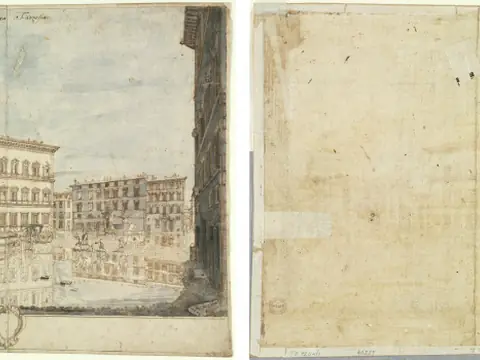
- Eighteen Views of Rome: The Piazza Farnese (recto); Cartouche (verso), Lievin Cruyl (1664) — Cleveland Museum of Art, CC0 1.0
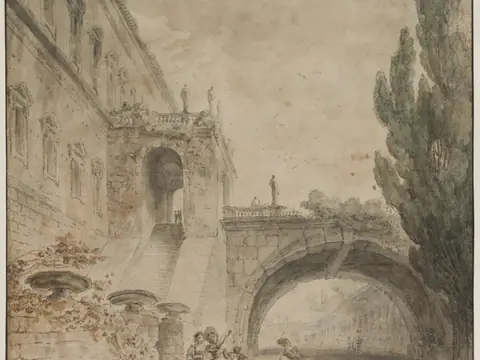
- A Palace with an Arched Bridge (A Roman Villa), Hubert Robert (1760) — Cleveland Museum of Art, CC0 1.0
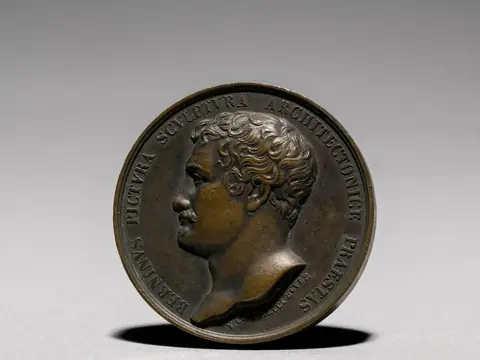
- Medal Depicting Gian Lorenzo Bernini (1598-1680) from the Illustrious Men of the Kingdom of the Two Sicilies (obverse), V. Catenacci (1830–34) — Cleveland Museum of Art, CC0 1.0
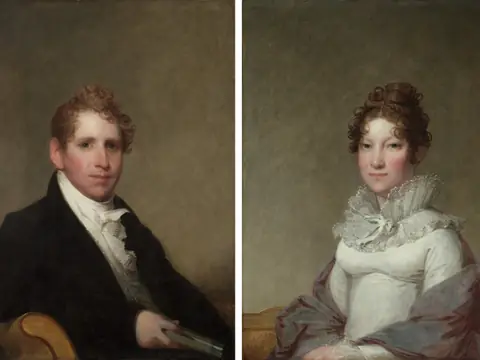
- Dr. James Stuart; Mary Campbell Stuart, Gilbert Stuart (c. 1815) — Cleveland Museum of Art, CC0 1.0
- Portrait of a Man, Gustave Caillebotte (1880) — Cleveland Museum of Art, CC0 1.0