
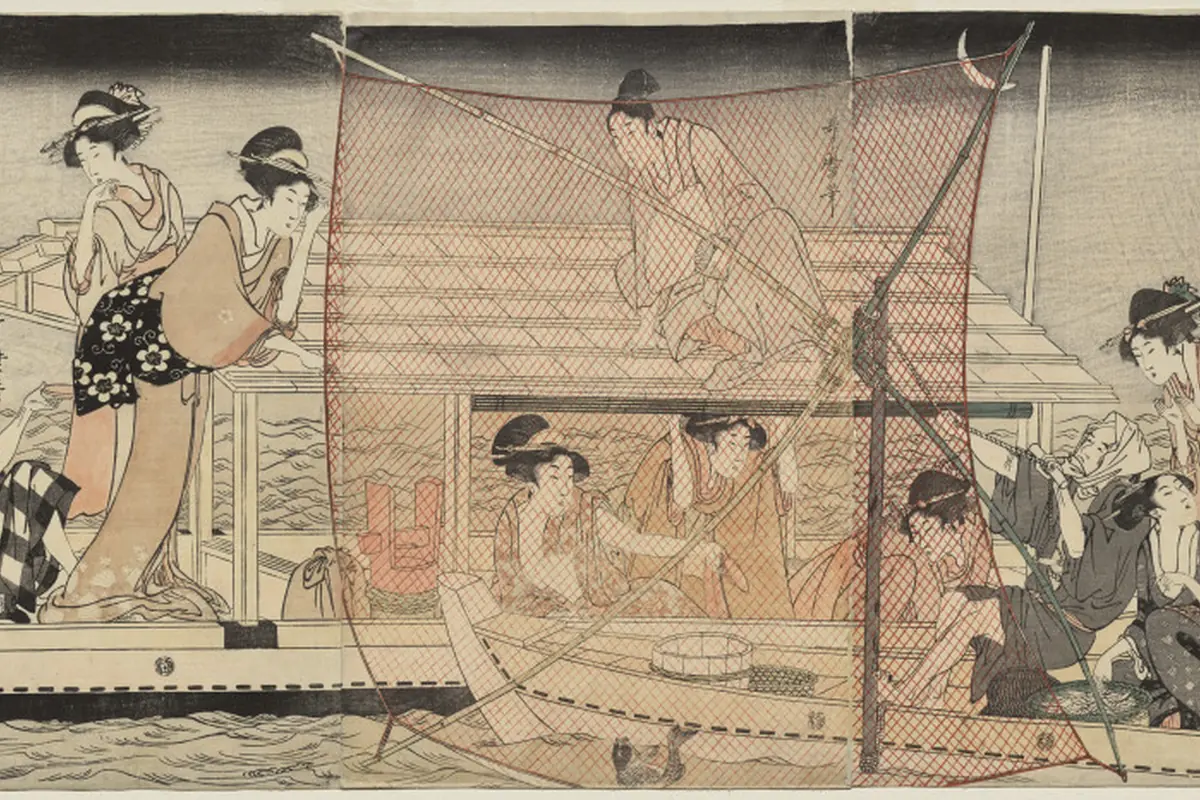
 Cleveland Museum of Art · CC0 1.0
Pages in this section
 The OIMAP – WCO agreementThe terms of cooperation with the World Customs Organization: purpose, commitments, training, shared tools and governance.›
 Border controlsHow customs spot and stop illicit cultural property: risk analysis, documents, indicators, seizures and follow-up.›
 Training of customs officersThe WCO – OIMAP training programmes: modules, formats, content, evaluation and access for administrations.›
Customs, the front line
Most illicit cultural property crosses at least one border. Customs officers are therefore the first who can stop it. The agreement concluded in 2016 with the World Customs Organization (WCO) gives them the tools to recognise such property and act.
It rests on three pillars: training, identification tools and information exchange. Forty-one States now take part in the joint programmes, and 8,940 officers have been trained since 2016.
The section presents the agreement, border controls and training.
Cooperation with the WCO in figures
Source: OIMAP Heritage Protection Department.
Why customs
Customs check goods, documents and travellers on entering and leaving territories. They have unique powers of control, seizure and investigation, and handle considerable volumes every day. Illicit cultural property goes unnoticed there, for want of tools and training.
The aim of the cooperation is to make these officers able to recognise a suspect object in a few minutes, check its documents and consult the BIOP database.
What each partner does
The WCO brings its network of 185 administrations, its exchange channels, its training procedures and its customs nomenclatures. OIMAP brings knowledge of cultural property, the experts and the BIOP database. Together they produce training materials, guides and sheets.
The two organisations hold regional training sessions each year, adapted to the types of trafficking in each region, and practical exercises in ports and airports.
Concrete results
In 2024, the customs services of participating States reported 1,140 cases of suspect cultural property, of which 310 were confirmed by OIMAP experts. Seizures rose by 22% compared with 2023. Use of the BIOP database at borders has doubled in two years.
These results are encouraging but remain partial: many crossing points are still poorly equipped. Extending the programme to new States is a priority.
A cooperation to widen
The WCO – OIMAP programme remains uneven across regions. States in Africa and South-East Asia, particularly affected by transit, are among the most in need of support. The Protection Fund finances training and equipment in these regions.
In time, the aim is for every important border post to have a trained officer, access to the BIOP database and an identification guide suited to the most frequent property.
The pillars of the WCO agreement
| Pillar | Content | Result |
|---|---|---|
| Training | Modules and exercises | 8,940 officers |
| Tools | Sheets, customs codes | 142 sheets |
| Information | Exchange of alerts | 1,140 cases reported |
| Operations | Coordinated controls | 12 operations |
Landmarks
- WCO – OIMAP agreement
Signature.
- First training module
Twelve States.
- Identification sheets
First series.
- 41 States
Programme extended.
One more check does not block trade
Systematic or targeted control
Systematic
All goods- Maximum coverage
- Slows down trade
- Costly
Poorly suited.
Targeted
Risk analysis- Quick
- Relies on the BIOP
- Requires training
Choice of the WCO and OIMAP.
Joining the programme
- Designate
Name the customs correspondent.
- Train
Enrol the officers.
- Equip
Use the sheets and the BIOP.
- Check
Target consignments.
- Report back
Transmit the results.
Priority crossing points
A customs director
« The training changed our outlook: an object badly described on a manifest is no longer a simple paperwork problem. »
Vocabulary of customs
- WCO
- World Customs Organization.
- Manifest
- List of the goods in a shipment.
- Risk analysis
- Selection of consignments to check.
- Nomenclature
- Classification of goods.
Frequently asked questions
Can my State take part?
Yes, through its customs administration.
Is the training free?
Yes for Member States.
Where can I find the sheets?
How do I report a case?
Through the agreement's line or the form.
Useful documents
Contacts
Related pages
 The OIMAP – WCO agreementThe terms of cooperation with the World Customs Organization: purpose, commitments, training, shared tools and governance.›
 Border controlsHow customs spot and stop illicit cultural property: risk analysis, documents, indicators, seizures and follow-up.›
 Training of customs officersThe WCO – OIMAP training programmes: modules, formats, content, evaluation and access for administrations.›
Read the agreement
Image credits (19)
- Net Fishing at Night on the Sumida River, Kitagawa Utamaro (c. 1800) — Cleveland Museum of Art, CC0 1.0
- Return of the Fishing Boats at Collioure, near the Spanish Border, Adolphe Appian (1878) — Cleveland Museum of Art, CC0 1.0
- Boating in Moonlight (1600s) — Cleveland Museum of Art, CC0 1.0
- Ferry Slip, Edwin Kaufman (1927) — Cleveland Museum of Art, CC0 1.0
- The Victory Banquet: from Battle Scenes of the Quelling of Rebellions in the Western Regions, with Imperial Poems (c. 1765–74; poem dated 1760) — Cleveland Museum of Art, CC0 1.0
- A Rocky Cove with Fishing Boats, Allart van Everdingen (late 1650s) — Cleveland Museum of Art, CC0 1.0
- Nuova pianta di Roma data in luce da Giambattista Nolli l’anno MDCCXLVII, known as La Pianta Grande di Roma, Giovanni Battista Nolli (1748) — Cleveland Museum of Art, CC0 1.0
- Enjoying the Evening Cool Along the Sumida River, Kitagawa Utamaro (c. 1797–98) — Cleveland Museum of Art, CC0 1.0
- Portrait of John VIII Palaoelogus, Emperor of Constantinople, 1424-1428 (reverse), Pisanello (c. 1438–1439) — Cleveland Museum of Art, CC0 1.0
- Nuova pianta di Roma data in luce da Giambattista Nolli l’anno MDCCXLVII, known as La Pianta Grande di Roma, Giovanni Battista Nolli (1748) — Cleveland Museum of Art, CC0 1.0
- The Storm, James McNeill Whistler (1861) — Cleveland Museum of Art, CC0 1.0
- The Dance at the Court of Herod, Israhel van Meckenem (c. 1500) — Cleveland Museum of Art, CC0 1.0
- The Fleet Off the Coast, Beachy Head, Samuel Atkins (c. 1790–1805) — Cleveland Museum of Art, CC0 1.0
- View of Venice, Jacopo de' Barbari (1500) — Cleveland Museum of Art, CC0 1.0
- Eighteen Views of Rome: The Piazza Farnese (recto), Lievin Cruyl (1664) — Cleveland Museum of Art, CC0 1.0
- Coronation of the Virgin, Christoffel Jegher (1632–36) — Cleveland Museum of Art, CC0 1.0
- Ships near the Trieux River, Paul Signac (1925) — Cleveland Museum of Art, CC0 1.0
- A Boat That Has for Sails the Wings of a Huge Bird, Filippo Morghen (about 1769) — Cleveland Museum of Art, CC0 1.0
- Bridge of Shops, Srinagar, Kashmir, Samuel Bourne (1864) — Cleveland Museum of Art, CC0 1.0